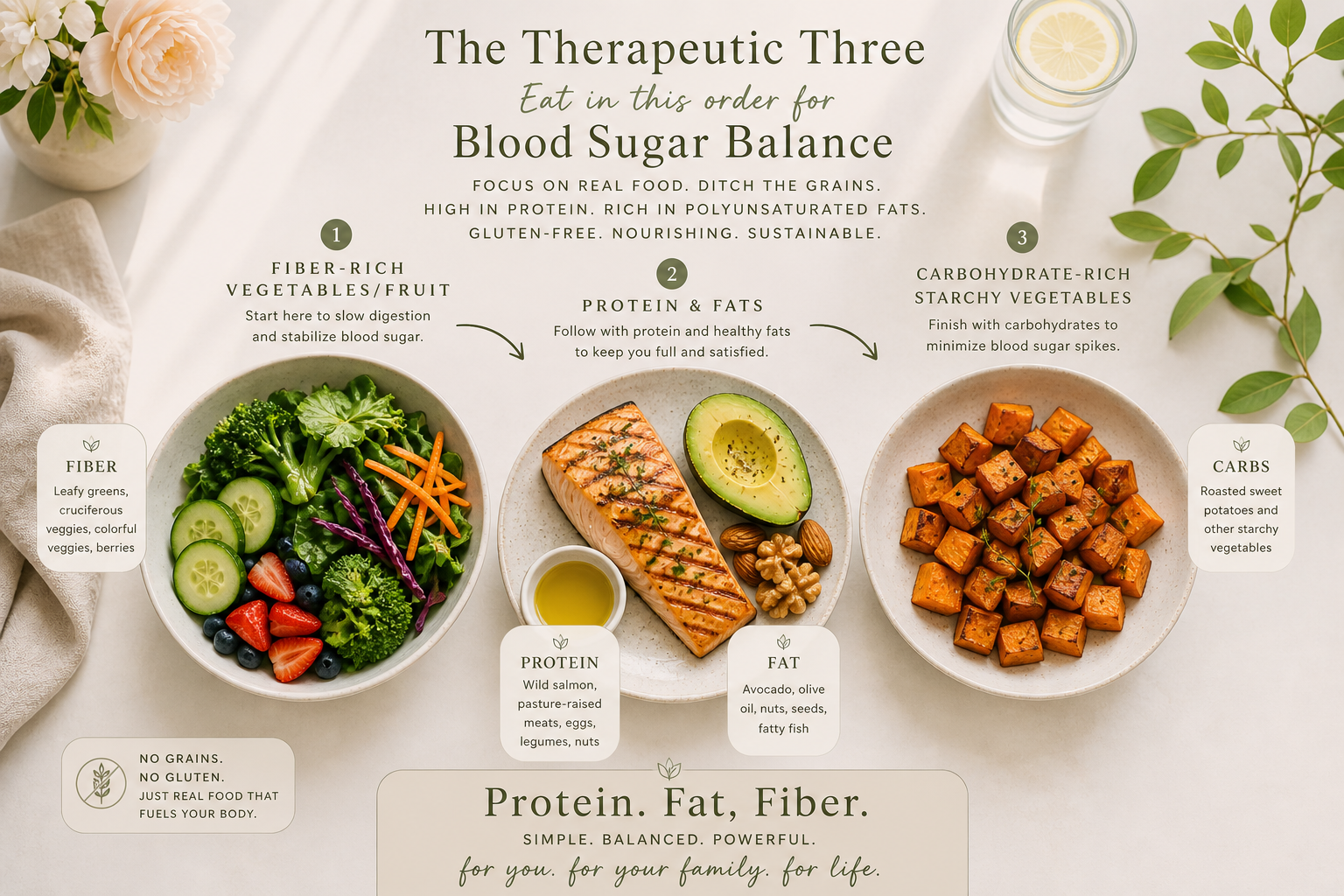
The Therapeutic Three
Protein, Fat, and Fiber: The Blood Sugar Balancing Trifecta Worth Talking About
The war on sugar has left a lot of people feeling confused at best and guilty at worst.
Like… are we really supposed to feel bad about having waffles on a Sunday morning with our family? Or grabbing something sweet in the middle of the day?
Because if that is the case, it is no wonder people feel stuck between wanting to be healthy and actually enjoying their life.
Here is the good news. You do not need to cut out sugar to support your health. You just need to understand how to eat in a way that works with your body.
That is where I like to introduce what I call the Therapeutic Three: protein, fat, and fiber.
No supplements, no expensive health food store haul. Just real food, used strategically.
What Is Blood Sugar (and Why It Matters More Than You Think)
Blood sugar is simply the amount of glucose circulating in your bloodstream at any given time.
At any moment, you only have about one teaspoon of sugar in your blood. That is it. Which is kind of wild when you think about how much sugar we can eat in a single sitting.
Glucose itself is not the problem. It is actually essential. Your cells rely on it for energy.
If you want a simple visual:
Your cells are like cars
Glucose is the gas
No gas, no movement.
What Happens When We Eat
Every time you eat, your body breaks food down into usable parts.
You have your macronutrients: protein, fat, and carbohydrates
And your micronutrients: vitamins, minerals, and phytonutrients
Carbohydrates are the main nutrient that break down into glucose and directly raise your blood sugar.
So when you eat something like waffles with syrup, sweetened oatmeal, or a croissant on its own, your body breaks that down quickly and releases glucose into your bloodstream just as fast.
That is when things can start to get a little chaotic.
The Blood Sugar Spike Situation
Your body likes stability. It is constantly trying to keep your blood sugar in a relatively tight range.
When glucose floods into the bloodstream quickly, your body responds by releasing insulin.
Insulin is a hormone that acts like a signal. It tells your cells, “Hey, there is energy available, let it in.”
When insulin binds to your cells, it triggers them to open up and allow glucose to move from the bloodstream into the cell, where it can be used for energy.
If we go back to the car analogy:
Your cell is the car
Glucose is the gas
Insulin is what opens the gas cap so the fuel can actually get into the tank
Without insulin, the gas is there, but it cannot get where it needs to go.
But here is where it gets interesting.
If you are constantly hitting your system with large spikes of glucose, your cells can start to ignore insulin’s signal over time.
And honestly, the best way to explain this is with Shrek.
At the beginning, Donkey says something and Shrek responds. Totally normal interaction.
But after a while… Donkey keeps talking. And talking. And talking.
Eventually, Shrek just stops responding.
That is essentially what happens with insulin resistance. The signal is still there, but the cells stop listening as well.
Why You Should Care (Even If You Feel Fine)
It is easy to brush this off, especially if you feel healthy right now.
But blood sugar impacts a lot more than just diabetes risk.
It affects your energy, cravings, mood, hormones, metabolism, and honestly how you feel throughout the day.
This is not about never eating sugar again. It is about not feeling like you are on an energy rollercoaster every day.
Stabilizing Blood Sugar Naturally with the Therapeutic Three
If you want to support your blood sugar without overcomplicating your life, focus on building your meals around three things:
Protein
Fat
Fiber
These three work together to slow digestion, stabilize energy, and keep your blood sugar from spiking and crashing.
Protein: Not Just for Bodybuilders
Protein has somehow been branded as something only people in the gym care about, but in reality it is foundational for everyone.
It breaks down into amino acids, which your body uses for everything from building muscle and skin to producing hormones and neurotransmitters.
One of the biggest benefits of protein when it comes to blood sugar is that it slows digestion.
So when you eat protein with carbohydrates, the glucose is released more gradually instead of all at once.
It also helps you stay full longer, which naturally reduces those mid afternoon crashes where you are suddenly craving something sweet.
A simple place to start is aiming for around 30 grams of protein per meal, especially at breakfast.
And if that feels like a lot, just start with one meal. You do not have to overhaul everything overnight.
Fat: The Missing Piece for Most People
Fat has been misunderstood for a long time, but it plays a huge role in both hormone health and blood sugar balance.
It gives your body a slower, more steady source of energy and helps prevent those sharp spikes that come from eating carbohydrates on their own.
It also helps absorb fat soluble vitamins and supports brain health, which is largely made up of fat.
On a practical level, adding healthy fats to your meals helps you feel satisfied. Which means you are not constantly thinking about your next snack.
Think olive oil, avocado, nuts, seeds, butter, or ghee.
Simple additions, big difference.
Fiber: Your Built In Blood Sugar Buffer
Fiber is one of the most underrated tools for blood sugar balance.
Beyond digestion, it actually helps regulate how quickly glucose enters your bloodstream.
When you eat fiber rich foods like vegetables, it creates a sort of buffering effect in your digestive system.
Instead of glucose rushing into your bloodstream, it is released more slowly and steadily.
You can think of fiber as your body’s natural speed regulator.
Most people are not getting nearly enough. Historically, humans ate significantly more fiber than we do today.
A good goal to aim for now is around 25 to 35 grams per day.
How to Build a Balanced Plate
This does not need to be complicated.
At each meal, aim to include:
A protein source
A healthy fat
Fiber rich vegetables
And a carbohydrate
That combination alone will put you miles ahead when it comes to blood sugar balance.
The Best Order to Eat Your Food
Here is something most people do not realize.
The order you eat your food actually matters.
If you want to support your blood sugar:
Start with your vegetables
Then eat your protein and fat
Finish with your carbohydrates
This helps slow down how quickly glucose is absorbed.
Real life example. If you are out for Italian food, start with a salad, eat your chicken, then move into your pasta.
If everything is mixed together, do not stress. Just focus on building balanced meals consistently.
Putting It All Together
This is not about perfection.
It is about understanding how your body works and using that knowledge in a way that actually fits your life.
You can still have the waffles. You can still have dessert.
The difference is now you know how to build meals that support your energy, your metabolism, and your long term health at the same time.
Start small. Add protein to your breakfast. Include fiber at your meals. Stop eating carbohydrates completely on their own when you can.
That is where real change starts.